Skip to content

No Reboundby Fiorella DiCarlo, RD, CDN, LDN

Log in

Afraid to stop your weight loss medication because of the rebound effect?

Created for women in menopause who are using GLP-1s and are afraid of the rebound effect. Built by Fiorella DiCarlo, RD, CDN, LDN.

On Ozempic, Wegovy, Mounjaro, Zepbound, or retatrutide*. In perimenopause, menopause, or after it.

See your rebound risk

Two minutes. No sign-up to start.

*Retatrutide is in phase 3 clinical trials (Eli Lilly) and is not yet FDA approved.

Your result

Your corridor

Your pattern: Rebound RiskThe weight you lost is the weight most at risk, and menopause makes it harder to hold.

177.2 lbs166.8 lbs

Your corridor is 166.8 to 177.2 lbs. That range is normal fluctuation, not drift. We’ll tell you if the trend leaves it.

Continue

Your metabolism changed the rules. Nobody handed you the new ones.

Six thousand women reach menopause every day in the United States. Around seven in ten gain weight through midlife, about a pound and a half a year, and it settles in the middle. That isn't a willpower problem. It's estrogen dropping and metabolism slowing, and it happens to women who did everything right.

GLP-1 medications work as well after menopause as before it. Millions of women are on one for exactly this reason. But the medication quiets your appetite. It doesn't rebuild the metabolic baseline the transition took away. And in menopause, fast weight loss carries a cost younger patients don't pay: muscle and bone go with the fat unless protein and movement hold.

Then the medication stops, or the dose comes down, and there was never a plan for the part after.

That plan is this app.

Why the rebound hits harder in menopause

When a woman stops a GLP-1, her appetite and cravings return to normal. Her metabolic rate does not.

  1. 1

    The muscle loss penalty

    Rapid weight loss on a GLP-1 takes muscle along with fat. Muscle burns far more at rest than fat does, so losing it lowers your resting metabolic rate. Off the medication, your body needs fewer calories to hold the same weight than it did before.

  2. 2

    It comes back to the middle

    The body works to restore its old weight. Menopause has already shifted fat storage toward the midsection, so regained weight lands disproportionately as visceral fat around the organs, not spread evenly.

  3. 3

    Hormonal resistance

    The medication never touched the estrogen drop that slowed your metabolism in the first place. Stopping it means returning to a body that is wired to store fat, unless the daily habits that protect muscle and bone are already in place.

Four questions that protect what matters

Not a food diary. Two minutes a day on the four things that decide how this goes.

  • Protein. The single biggest lever against muscle loss while the medication is doing its work, and the first thing to slip when appetite is quiet.

  • Produce. Fiber, fullness, and the gut side of the transition that nobody talks about.

  • Movement. Not a workout log. Just whether you moved today, because muscle and bone are built by moving, not by watching the scale.

  • Hunger. Quiet, normal, or loud. Over weeks this is the signal that tells you where you are in the transition.

Nothing is forbidden and nothing is graded. Miss a day and pick it back up.

Daily check-in

Hunger today

6

No hungerRavenous

Continue

Weight, tracked in a corridor

A menopausal body fluctuates. Water, hormones, sleep, a salty dinner. A daily verdict from the scale reads every one of those as failure.

  • Your corridor is a range around where you are now, not a target
  • One quiet flag if the trend leaves the range, so you catch drift in weeks instead of months

Trends

Weight

171.3lbs avg

Your corridor: 166.8 to 177.2 lbs. Inside that range is normal fluctuation, not drift.
Know which hunger it is

On a GLP-1 your appetite goes quiet. In menopause it comes back changed. Either way, when hunger shows up it comes in two kinds, and they need different answers.

  • Every meal asks one question: physical hunger or mouth hunger
  • Physical hunger gets fed, and the app helps you make it protein. Mouth hunger gets noticed, without a lecture

Log what you ate

Which hunger was this?

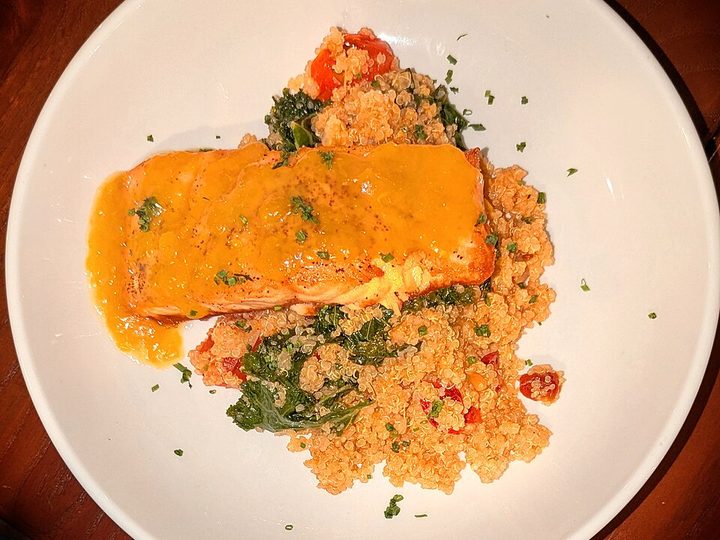
Log a meal with your camera or a sentence

Point your phone at the plate, or type what you ate the way you'd say it out loud. We handle the rest.

  • A photo of the plate comes back with protein and produce in seconds
  • "Two eggs, toast, coffee" works too. No barcodes, no databases, no gram weights

Log what you ate

Your meal photo

A plate of salmon on quinoa with kale and tomato

Read from the photo. Check the numbers, then save.

Salmon fillet · 5 oz34g
Quinoa · 3/4 cup6g
Kale and tomato · 1 cup3g
Protein43g
Save entry

Fiorella in your corner, every week

She is the coach. Her protocol sets every rule, and the weekly read and the daily nudge are written from it and your own data, not from a generic chatbot.

  • Every week: what actually moved and what only felt like it moved, in her voice, reviewed before it reaches you
  • Every day: one line from her menopause protocol. After a hard week, a couple of gentle follow-up questions, never a lecture

Today

Welcome back, Dana.

This week

Week of August 17

Protein held on the days sleep did.

Five of seven days landed at goal, and the two that slipped followed your two shortest nights. The weight trend stayed inside the corridor all week. One thing for next week: the first meal after a short night, a little earlier.

5 days in a row

How it works

  1. 1

    Set your corridor.

    Tell us where you are: in perimenopause, menopause, or after it, and on the GLP-1, tapering, or off it. Where you are now, or where you finished, becomes a range, not a goal.

  2. 2

    Check in daily.

    Four questions. Two minutes.

  3. 3

    Watch the trend.

    Weight and habits on the same timeline, so you can see which one moves first.

  4. 4

    Adjust early.

    Catch drift while it's still a small correction.

Who it's for

  • In menopause, on a GLP-1.

    This was built for you. The medication is handling appetite; the app handles muscle, bone, and the part after.

  • In perimenopause, on a GLP-1.

    The transition has started and the scale has noticed. The check-in and the corridor work exactly the same way.

  • At your goal, tapering.

    The months around the last dose decide whether the weight holds. Protein, hunger, and a plan for when the dose comes down.

  • Off the medication.

    The window that matters most. Appetite returns; the corridor tells you if the weight is.

Who built it

Fiorella DiCarlo, RD, CDN, LDN, is a registered dietitian who has spent her career on menopause nutrition, and the last several years on GLP-1s and the conversation that starts after the prescription ends. She has been featured on Fox News, PBS, and NBC, and in Forbes, Women's Health, Health.com, EatingWell, and Prevention.

The check-in, the corridor, and the rules behind every insight are hers. This is what she gives her patients, now on your phone.

Everything included. Two ways to pay.

Most popular

Six months

$59.99 for six months

That's $10 a month. Save $30.

Monthly

$14.99 a month

7-day free trial, then $14.99 a month. Cancel anytime.

Both plans include:

  • Daily check-in and corridor tracking
  • Hunger type and meal rhythm
  • Food logging in plain language
  • Carbs and fiber, read for quality
  • Weekly coaching read in Fiorella's voice
  • Full history, all the way back
  • Corridor alerts
  • Export your data

You pick your plan after your results. Both start with a free week.

See your rebound risk

Ready for the part after?

The assessment takes two minutes. Your corridor is set a minute after.

See your rebound risk

No Rebound is a tracking tool. It is not medical treatment or diagnosis. Always work with your prescribing physician.

*Retatrutide is in phase 3 clinical trials (Eli Lilly) and is not yet FDA approved.

AboutFAQAssessmentWhat's newStatusPrivacyTermsContact

© 2026 No Rebound. Built by Fiorella DiCarlo, RD, CDN, LDN.